Travel
How transport is contributing to carbon emissions
Carbon emissions from transport within the Cheshire East borough equates to 34% of total borough carbon emissions. The use of petrol and diesel in vehicles is contributing to the borough’s carbon emissions.
The graphs shows carbon emissions from the transport sector in Cheshire East from 2005-2019 (data from Department for Business, Energy and Industrial Strategy). These are split into emissions from different road categories, diesel rail and other. The overall trend shows a reduction however we know this can be reduced further to help Cheshire East become carbon neutral by 2045!
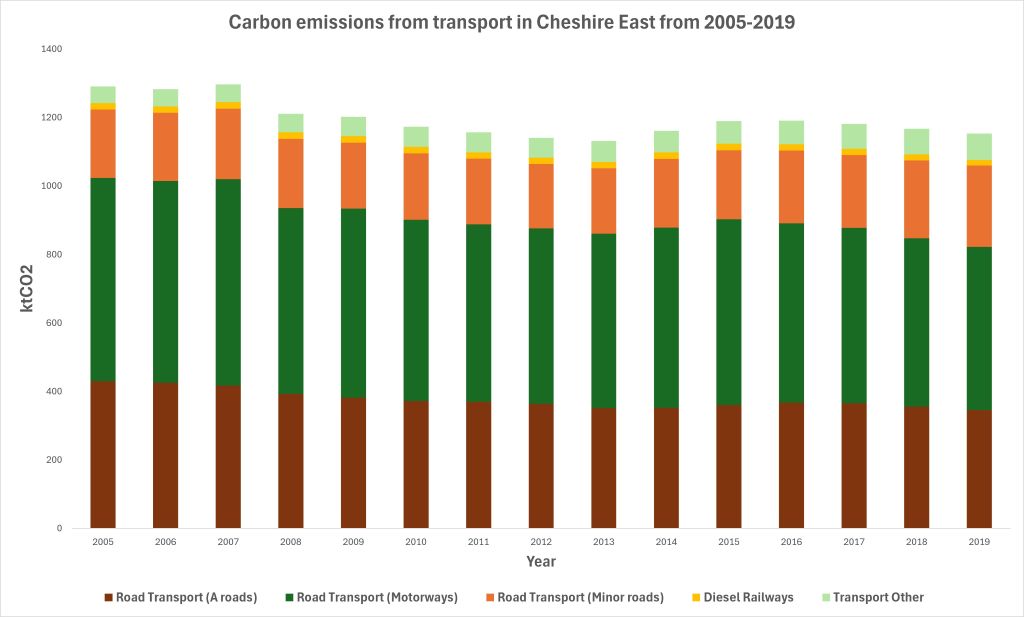
Carbon emissions from transport in Cheshire East from 2005 to 2019 (JPEG, 61KB)
There are many ways you can help to reduce these emissions within the transport sector.
Active travel
Public transport
Car sharing
Electric vehicles
Active Travel
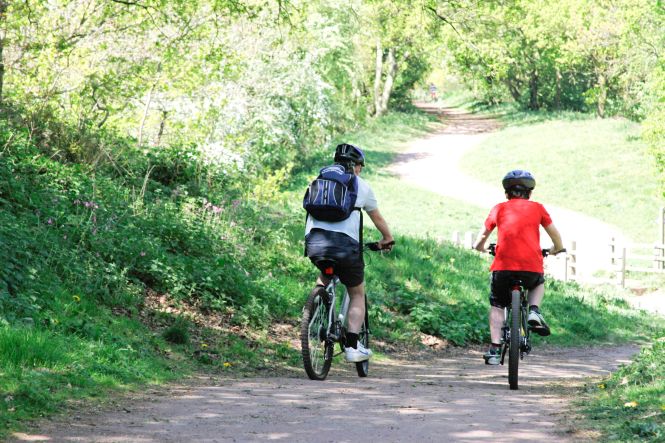
Active Travel is a great way to reduce your carbon emissions while also benefiting your health! Active Travel is opting for a bike or walking instead of using a vehicle – it makes you happier and healthier. The Cheshire East Travel Strategy reports that 85% of households in Cheshire East own a car, which is greater than the national average of 76% and the North West’s average of 75%. There is a great dependency on cars - with 60% of journeys taken being under 10km. Opting for walking and cycling over local journeys can benefit both physical and mental wellbeing, as well as have the greatest potential on carbon reduction.
 By ditching your car for a form of active travel, not only are you reducing your carbon footprint and improving your health and wellbeing, but you are also helping to improve local air quality by eliminating carbon dioxide, nitrogen dioxide and particulate matter emissions as well as reducing congestion on our roads.
Active Travel England wants to increase the number of local journeys being walked, wheeled or cycled by 2030. Cheshire East Council has plans which are underway with funding from Active Travel England to improve active travel within the borough. In 2025, Cheshire East Council was the first authority in the North West to improve its capability rating level from Level 1 to Level 2.
Examples for active travel:
- cycling and walking to work
- cycling and walking for local journeys
- cycling and walking to school
Public Transport
Public transport is important in decarbonisation efforts as it reduces carbon emissions through efficient travel. The Cheshire East Bus Partnership fund enhances bus services within the area by improving services and growing passenger numbers, encouraging changes in travel behaviour. Trains are another good public transport option for those longer journeys, especially to UK main cities. Railcards are available for Cheshire East residents, enabling 1/3 off rail tickets.
 Railcard information for train journeys
Buses and public transport in Cheshire East
Bus Services
Bus stop and routes map in Cheshire East
Car sharing
Car sharing is another initiative which can be taken to reduce the number of vehicle miles on the roads. This is a great idea for businesses and communities, as not only does it help reduce carbon emissions but could also help with parking issues and costs.
Car sharing scheme from the Energy Saving Trust
Car sharing scheme from Green Citizen
Electric Vehicles
Electric vehicles are a great way to reduce your carbon footprint and to reduce vehicle carbon emissions. From 2030, the phase out of petrol and diesel cars will begin nationally with the UK government banning new sales of fully petrol and diesel vehicles. In 2025, 23.4% of vehicles sold were fully electric, up from 2% in 2022. As of March 2026, there are 1.97 million electric cars in the UK making 5.7% of all cars on the road.
By 2035, national targets have been set so new vehicles are 100% electric.
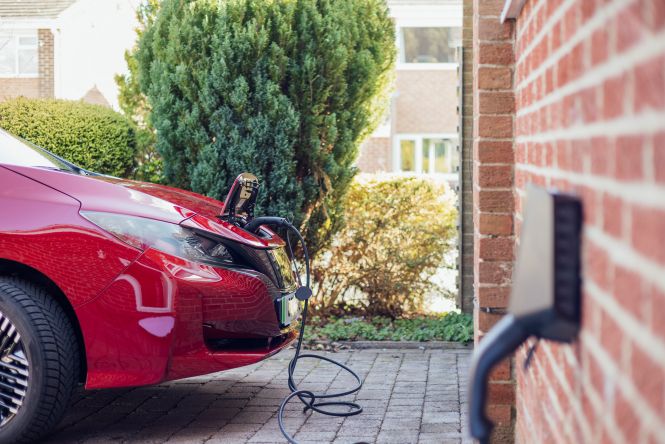
We recognise that charging facilities are an important factor in this transition. Cheshire East Council has secured more than £2.3 million in funding through the On-Street Residential Chargepoint Scheme (ORCS) and the Local Electric Vehicle Infrastructure Fund, (LEVI) so that electric vehicle chargers can be installed in 175 sites across the borough.
There are maps available to show where electric vehicle chargers are in your local area.
Electric Vehicle Myths:
Myth - Electric vehicles are more expensive than petrol or diesel cars.
Electric vehicles can be more expensive to buy however; they are reaching price parity. Charging a medium-sized electric vehicle costs less than half the price of fuel for a petrol equivalent vehicle. Costs vary but EV's can cost 3-9 pence per mile versus internal combustions engines at 15-17 pence per mile.
GOV.UK - electric vehicle costs
Myth - Not enough electric vehicle chargers
There are lots of electric vehicle charging points throughout the UK. As of October 2025, there were 86,021 public electric vehicle chargers in the UK. In Cheshire East, we are supporting the transition to electric vehicles by facilitating the installation of EV chargers in public spaces.
GOV.UK - electric vehicle chargers
Myth -Electric vehicle battery life is poor
The UK government states that new regulations ensure that there are warranties for electric vehicle batteries of 8 years or 100,000 miles. Manufacturers need to provide replacements if the battery level is below 70% for cars and 65% for vans. This warranty is 5 years more than warranties for petrol and diesel vehicles.
Electric vehicles: costs, charging and infrastructure - GOV.UK
Myth - electric vehicle carbon footprint is the same as a petrol or diesel vehicle
Electric vehicles can be more carbon intensive to manufacture, but overall electric vehicles emit 73-78% less greenhouse gas emissions than its petrol equivalent over their lifetime. As manufacturing techniques improve, the carbon emissions from EV's production is reducing.
Electric cars lifcycle analysis
Myth - electric vehicles have a limited range
The UK government reports that most journeys taken in the UK are under 100 miles. Most electric vehicles can complete this journey distance without needing to recharge. In 2011, the average range of an electric car was 80 miles, EV's today are 300-400 miles with the best being 575 miles.
Electric vehicles: costs, charging and infrastructure - GOV.UK
Page last reviewed: 23 October 2026
Thank you for your feedback.