Budgeting icons

Cheshire East budget

Cheshire East Council Budget

Help shape the council's priorities for the year ahead

We're asking residents to tell us what matters most to them as we plan our budget and services. Take part in our budget prioritisation survey and have your say

How the council's budget is spent

A significant proportion of the council's spending supports some of the most vulnerable people in our communities.

Adult social care and children's services account for around 70% of the council's budget. This includes services such as social care and safeguarding for vulnerable children, support for adults with disabilities and complex needs, and care for older residents who require additional assistance.

Many of these services operate behind the scenes and are not always visible in the same way as services such as road maintenance, libraries, waste collection and environmental services. However, they represent a substantial part of the council's responsibilities and spending.

The budgets for adult social care and children's services include the full cost of delivering these services, including staffing, facilities, technology, transport, contract costs and other support functions that enable services to operate effectively.

Like councils across the country, Cheshire East continues to face significant financial pressures, particularly from increasing demand for social care and support services. At the same time, the council must continue to deliver a wide range of services that residents rely on every day.

The council's budget is funded from a number of sources, including council tax, business rates, government funding, fees and charges, and other income. You can find a full breakdown of how the council is funded and how money is spent in the Medium-Term Financial Strategy and the Your Council Tax 2026/27 booklet (PDF, 1.2MB).

To help the council meet its statutory duties and maintain essential services, councillors approved a council tax increase of 4.99% for 2026/27, alongside a package of savings, income-generating measures and investment proposals. The government has also approved in principle the council's request for Exceptional Financial Support (EFS) (PDF, 180KB)

How your feedback shapes our decisions

We consult with residents on key budget proposals, and the insights you provide help to shape our future spending plans. We publish the results of our consultations so you can see the impact your views have had.

For next years budget, we will be holding some community assemblies with residents invited through our Community Voices Panel. You can join to take part in future discussions.

Where your council tax goes

Council tax funds the services that people rely on every day.

How each £1 of your council tax is used

The following checkboxes are used for accordion drop-downs. When selected, they show content that was visually hidden

  • 69.2p - Social care services
  • 10.7p - Waste management and street cleaning
  • 9.3p - Education support including home–school transport
  • 4.8p - Highways and public transport
  • 2.8p - Homelessness and planning
  • 2.2p - Museums, parks and libraries
  • 1p - Licensing, elections and trading standards

These costs already include the staffing costs, such as salaries and pensions, required to deliver them.

Even if you don’t see these services directly, someone nearby depends on them daily – whether it’s a vulnerable child receiving care, an older resident being supported at home, or helping a young person with special educational needs get to school.

Did you know

services

The following checkboxes are used for accordion drop-downs. When selected, they show content that was visually hidden

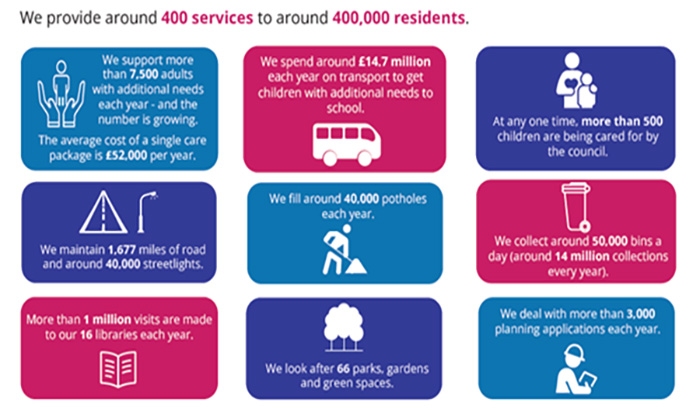
  • We support more than 7,500 adults with additional needs each year - and the number is growing. The average cost of a single care package is £52,000 per year.
  • We spend around £14.7 million each year on transport to get children with additional needs to school.
  • At any one time, more than 500 children are being cared for by the council.
  • We maintain 1,677 miles of road and around 40,000 streetlights.
  • We fill around 40,000 potholes each year.
  • We collect around 50,000 bins a day (around 14 million collections every year).
  • We deal with more than 3,000 planning applications each year.
  • More than 1 million visits are made to our 16 libraries each year.
  • We look after 66 parks, gardens and green spaces. 

“You can view the ‘Your Council Tax 2026/27’ booklet, which explains how each £1 of your council tax is spent, the services that council tax helps to fund, and how the council’s budget for day-to-day services is funded.”

Why social care costs so much

Social care is funded through council tax - not by the NHS.

The cost of providing care is rising sharply, and demand for these essential services is growing faster than the funding available.

Without council funded social care, pressure on local hospitals would increase significantly.

Our Medium Term Financial Strategy 2026-2030

This report provides detailed information on the issues facing the council in the medium term and shows how these are being addressed to present a balanced financial position for the 2026/27 financial year.

The strategy includes: 

  • How your council is funded (such as government grants, business rates and council tax)
  • The budget for each committee and plans for the next four years
  • Capital investment plans
  • Strategies for reserves, investment, and treasury management 

Exceptional Financial Support

We have built £25 million in Exceptional Financial support into the budget for 2026/27, which is equivalent to 5% of the budget. Exceptional Financial Support does not mean we get cash from government. It means we are allowed to borrow, or use income from sale of assets, to close the funding gap.

Borrowing means taking on a long-term commitment to pay interest. So, it’s a short-term fix to give us more time to build long-term financial sustainability.

What are we doing to fix our financial position?

We are committed to delivering the best possible services, protecting our most vulnerable residents and ensuring our borough is an even better place to live, work and thrive.

However, this has become increasingly difficult. Demand in areas such as children’s social care, adult services and special educational needs are growing faster than our funding.

We are in the process of transforming and adapting to meet these challenges. Our Improvement and Transformation Delivery Plan sets out our priorities and what we need to do. This includes reviewing all the services we deliver, the resources, tools and processes we use, the jobs we all do and the way we are organised.

We have now reviewed the scale, timing and delivery of our transformation programmes for the coming years, including how and when we will realise transformation savings.

  • Some services must be delivered differently and more efficiently.
  • Others will need to reduce or stop altogether.
  • And we will work with partners to find new ways of meeting local needs.

We are addressing our challenges with a focus on delivering value for money, continuous improvement and better outcomes for Cheshire East’s residents.

We are confident that with the right resources, focus and commitment, we can deliver the actions in our plan at the pace required, resulting in real improvements and a sustainable financial position for the long term.

Stay connected

You can stay informed and involved all year round:

Council tax support

If you need support with your bill, our Council Tax Support Scheme can help residents on low incomes. You may be entitled a council tax reductions, or may not have to pay council tax, depending on your circumstances.

You can also find help with food, energy costs, warm spaces and benefits through our cost of living pages.

Page last reviewed: 02 July 2026