Principles of the Graduated Approach
The below principles should be adopted at all stages of the Graduated Approach, not just for children and young people that are undergoing EHC needs assessments or have an EHC Plan in place.
6.1. Assess, Plan, Do and Review
According to The SEND Code of Practice: 0-25 years (January 2015), supporting children and young people with SEN via the Graduated Approach includes the use of a four-part cycle of ‘Assess, Plan, Do and Review.
Through this cycle, earlier decisions and actions are revisited, refined and revised with a growing understanding of the child or young person’s needs and of what supports the child or young person in making good progress and securing good outcomes. It draws on more detailed approaches, more frequent review and more specialist expertise in successive cycles in order to match interventions to an individual child or young person’s needs.
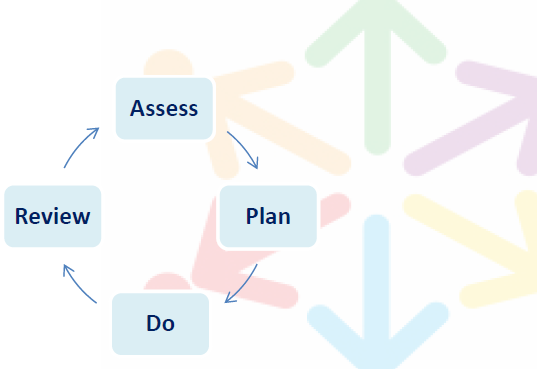
The following paragraphs provide a brief overview of the general principles for each stage of this cycle, based on The SEND Code of Practice: 0-25 years (January 2015):
Assess – a clear analysis of the child or young person’s needs should be carried out by those teaching and supporting the child or young person – this includes the early years key person, the class teacher(s) or the tutor/lecturer in conjunction with the SENCO or additional learning support team.This initial assessment should be reviewed regularly to ensure that support is matched to need. Where there is little or no improvement in the child or young person’s progress, more specialist assessment may be called for from specialist teachers or from health, social care or other agencies beyond the setting. In some cases, outside professionals from health or social care may already be involved with the child. These professionals should liaise with the educational setting to help inform the assessments. Where relevant professionals are not already working with the educational setting, staff from the educational setting should contact them (if parents agree for children and young people in early years or school).
Plan – Professionals within the educational setting (early years key person, the class teacher(s) or the tutor/lecturer in conjunction with the SENCO or additional learning support team) should work with the child or young person and their parents to agree the outcomes they are seeking, the interventions and support to be put in place, the expected impact on progress, development or behaviour, and a clear date for review. The support and intervention provided should be selected to meet the outcomes identified for the child or young person, based on reliable evidence of their effectiveness. Any related staff development needs should also be identified and addressed.
Do - The key person, class or subject teacher remains responsible for working with the child or young person on a daily basis (even where interventions involve group or one-to-one teaching). The SENCO/additional learning support team should support the key person, class or subject teacher or tutor/lecturer in the further assessment of the child or young person’s particular strengths and weaknesses, in problem solving and advising on the effective implementation of support.
Review - The effectiveness of the support and interventions, and their impact on the child or young person’s progress, should be reviewed regularly and in line with any agreed dates. The child or young person’s views should be taken into account during the evaluation of the quality and impact of the support provided. Professionals within the setting should revise the support in light of the child or young person’s progress and development, and decide on any changes to the support and outcomes in consultation with the child or young person and their parent(s).Educational settings should revisit this cycle of action, and refine and revise their decisions about support as they gain a richer understanding of the child or young person and what is most effective in helping them secure good outcomes. Support for all children and young people with SEN should be kept under review, regardless of whether or not the child or young person has an EHC Plan.
6.2. A person-centred approach
An individual child or young person with SEN should always be at the centre of any assessment or planning process that focuses on them and a person-centred approach should be used. Person-centred approaches are about discovering and acting on what is important to the child or young person, what is important for them and finding the balance between these. A person-centred approach reflects what a child or young person is able to do, what is important to them (now and in the future) and thinks about what support they might need in order to reach their potential. It is therefore a process of continual listening and learning. Being person-centred includes problem solving and thinking about how we can allocate the most appropriate support and resources in order to enable children and young people with SEN to work towards their aspirations. These resources may come from the child or young person’s own network and/or available support within the local community, not just from specialist services.
The SEND Code of Practice: 0-25 years (January 2015) emphasises the importance of using a person-centred approach during assessment and planning processes for children and young people with SEN. It states that assessment and planning processes should:
- focus on the child or young person as an individual
- enable children and young people and their parents to express their views, wishes and feelings
- enable children and young people and their parents to be part of the decision-making process
- be easy for children, young people and their parents or carers to understand, and use clear ordinary language and images rather than professional jargon
- highlight the child or young person’s strengths and capabilities
- enable the child or young person, and those that know them best to say what they have done, what they are interested in and what outcomes they are seeking in the future
- tailor support to the needs of the individual
- organise assessments to minimise demands on families
- bring together relevant professionals to discuss and agree together the overall approach, and
- deliver an outcomes-focused and co-ordinated plan for the child or young person and their parents
6.3. Co-production
Although there is no single definition of co-production, put simply, co-production means ‘making something together’. When applied to supporting children and young people with SEN, co-production describes children and young people with SEN, their parent carers, and professionals across multiple agencies and sectors working together as equal partners to design, plan, deliver and review support and services in order to achieve shared outcomes. Co-production recognises children and young people, parent carers and professionals as assets that all have important contributions to make due to their differing knowledge, skills and experience. Note that there is a difference between co-production and participation: participation means being consulted while co-production means being equal partners and co-creators. For co-production to be most effective, all partners should be brought in at the earliest opportunity when planning or designing support or services.
In line with The SEND Code of Practice: 0-25 years (January 2015), co-production should take place as far as possible at two levels for children and young people with SEN and their parent carers:
1) At an individual level
Children and young people with SEN, and their parents, must be involved in discussions and decisions about their individual support. To support this, children and young people and their parents should be provided with relevant information on their rights in accessible formats, along with time to prepare for discussions and meetings. For children and young people undergoing an EHC needs assessment or with an EHC Plan, The SEND Code of Practice: 0-25 years (January 2015) states that “Early years providers, schools and colleges should also take steps to ensure that young people and parents are actively supported in contributing to needs assessments, developing and reviewing Education, Health and Care (EHC) plans”. This includes capturing the views and wishes of children and young people with SEN, and their parents, in an accessible manner for the individual, which could involve the use of visuals, pictures etc. in order to capture the child or young person’s voice. Note that The Children and Families Act 2014 gives significant new rights directly to young people once they reach the end of compulsory school age (the end of the academic year in which they turn 16). When a young person reaches the end of compulsory school age, local authorities and other agencies should normally engage directly with the young person rather than their parent, ensuring that as part of the planning process they identify the relevant people who should be involved and how to involve them. Some young people may require support in expressing their views, which may include support from an advocate (who could be a family member or a professional). However, the views of parents must not be used as a proxy for young people’s views.
2) At a strategic level
The SEND Code of Practice: 0-25 years (January 2015) also states that children and young people with SEND, and their parents, must be involved in discussions and decisions about local provision. This includes involving children and young people with SEND and their parents in reviewing educational and training provision and social care provision, and in preparing and reviewing the Local Offer.

6.4. Improved outcomes for children and young people
In line with The SEND Code of Practice: 0-25 years (January 2015), we believe that there should be a strong focus on high aspirations and on improving outcomes for all children and young people with SEN. Outcomes are not a description of the support or provision that is in place for a child or young person. Instead, outcomes describe the benefit or difference made to an individual child or young person as a result of an intervention, and as such, there should be a focus on outcomes from the earliest stages of identifying and supporting children and young people with SEN. Any planning and delivery of support should always be focused on the outcomes that have been identified for the individual child or young person (i.e. how such support will contribute to achieving the agreed outcomes) and should be based on reliable evidence of effectiveness. Support should be reviewed regularly as part of the ‘Assess, Plan, Do, Review’ cycle and be adapted or replaced depending on how effective it has been in achieving the agreed outcomes.
The Code also states that with high aspirations, and the right support, the vast majority of children and young people can go on to achieve successful long-term outcomes in adult life. The local authority, educational settings and other services and partners should work together to prepare children and young people with SEN for adulthood and help them to realise their ambitions. The Graduated Approach and Preparation for Adulthood section of this document provides further information on the four nationally agreed Preparing for Adulthood outcomes for children and young people with SEN.
6.5. Training and Workforce Development
The successful delivery of a graduated approach to SEN is dependent upon the individuals involved in supporting children and young people with SEN (across all agencies and at all levels) having the appropriate skills and knowledge that they require to work effectively and efficiently.
This document provides educational settings with information and advice on identifying and supporting children and young people of all ages with different types and levels of SEN, but in order to fully embed this information and advice, all future local training on SEN will be based on and build upon this document. An ongoing multi-agency workforce development programme for SEND covering different specialisms and levels of expertise will ensure that professionals (and parent carers) have opportunities to further develop their knowledge and skills.